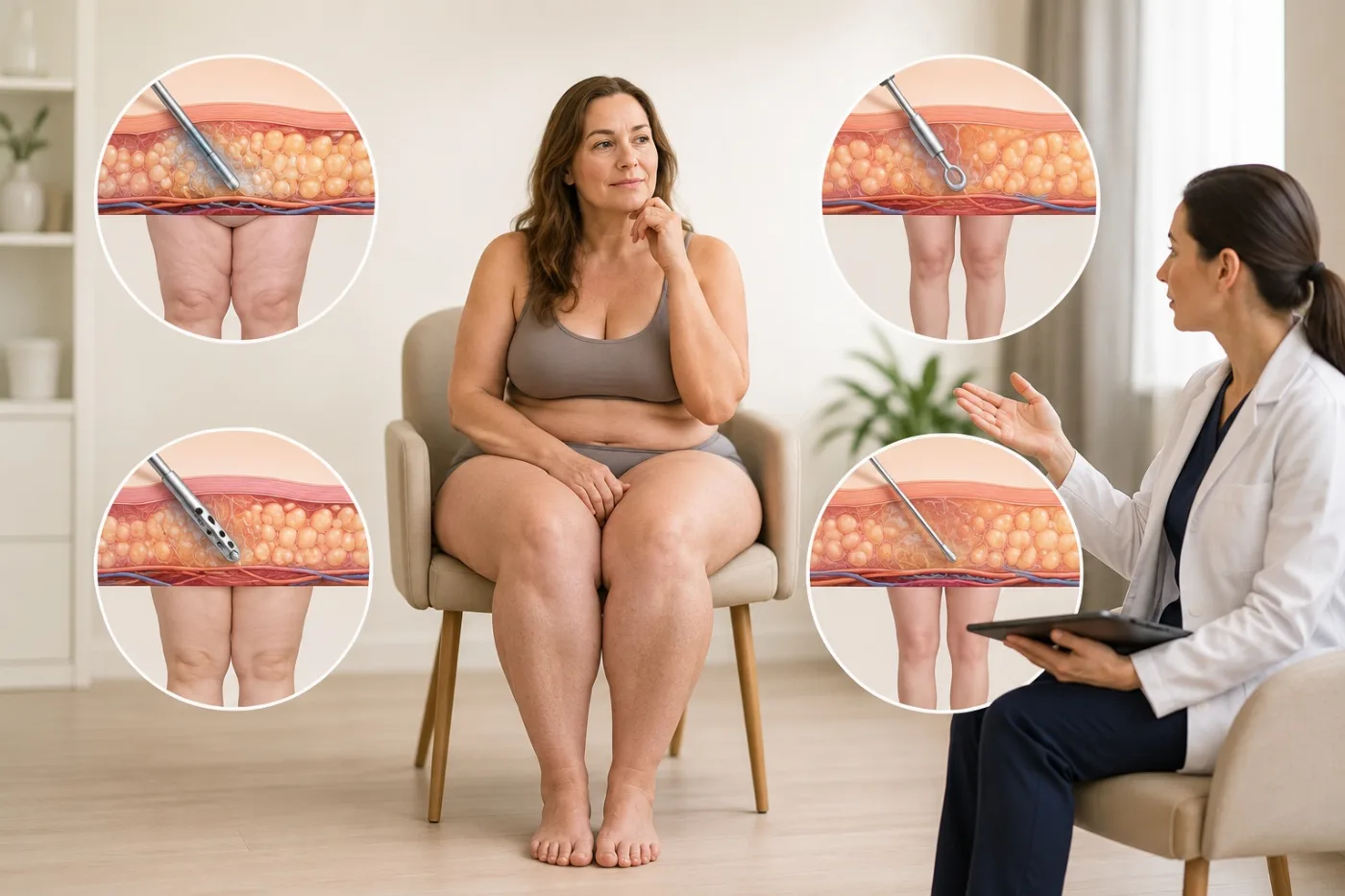
There is no single lipedema liposuction technique that is best for every patient. The right approach depends on factors such as tissue density, fibrosis, disease stage, treatment area, and prior procedures. For patients coming to Roswell near Canton Street, a specialized evaluation is the safest way to determine whether PAL, WAL, UAL, or a combination makes sense.
If you are considering surgery near the Chattahoochee Nature Center, call (770) 587-1711 or contact Byrd Lipedema Surgery Center to schedule a consultation and discuss which approach may fit your specific case.
Located near the Roswell Historic House Museums, Byrd Lipedema Surgery Center treats lipedema with several specialized liposuction techniques. Dr. Marcia Byrd evaluates each patient individually and may use more than one method when the tissue, treatment area, and surgical goals call for a customized approach.
What Is Power Assisted Liposuction?
Power assisted liposuction, commonly called PAL, uses a mechanically powered cannula that creates small, rapid movements while the surgeon removes fatty tissue.
Those movements help the cannula pass through the treatment area with less manual force than traditional liposuction. Byrd Lipedema Surgery Center uses PAL as part of its specialized approach to lipedema fat removal and notes that it can be combined with other techniques.
PAL can be particularly useful when tissue is dense or fibrotic. Because fibrosis can make lipedema tissue more difficult to remove, the surgeon needs to consider how firm the tissue feels and how much resistance is present before selecting the surgical approach.
How Does Water Jet Assisted Liposuction Work?
Water-jet assisted liposuction, or WAL, uses a fan-shaped stream of fluid to gently separate fat cells from surrounding tissue before they are suctioned away.
One of the reasons WAL is used in lipedema surgery is its tissue-sparing approach. The center describes the technique as designed to reduce trauma to surrounding lymphatics, connective tissue, nerves, and blood vessels compared with more conventional methods.
WAL may be used in patients across different lipedema stages and in areas where preserving surrounding structures is a major consideration. It is also sometimes combined with PAL rather than treated as an either-or choice.
That is an important distinction for prospective patients. Choosing a technique is not always about selecting one procedure from a menu. A surgeon may decide that different methods provide advantages in different parts of the same treatment plan.
When Is Ultrasonic Assisted Liposuction Considered?
Ultrasonic assisted liposuction, or UAL, uses ultrasonic energy to liquefy fat cells before they are removed.
This technique is particularly relevant when the tissue is dense or fibrotic. Byrd Lipedema Surgery Center explains that UAL can make extraction more efficient in areas where firmer fat deposits are harder to address with traditional methods.
UAL may also be considered for challenging treatment areas or for patients who have undergone previous liposuction. In some cases, the surgeon may combine it with PAL or WAL to tailor the procedure to the patient's anatomy and tissue characteristics.
For someone with later-stage lipedema or pronounced fibrosis, that ability to adjust the technique can be especially important.
Why Tissue Fibrosis Changes the Decision
Lipedema tissue does not remain the same in every patient or at every stage. As the condition progresses, fatty nodules can become firmer and more fibrotic.
That changes how easily tissue can be removed and how the surgeon approaches a particular area. A method that works well in softer tissue may not offer the same advantages in a highly fibrotic treatment area.
This is why choosing a lipedema liposuction technique based only on what worked for another patient can be misleading. Two people with the same diagnosis may have different stages, tissue density, affected areas, prior surgeries, or lymphatic considerations.
Using a technique that is poorly matched to the tissue can make effective removal more difficult. The goal is to select an approach that addresses the diseased fat while protecting surrounding structures and supporting the best achievable symptom improvement for that individual patient.
What Does the Surgeon Evaluate Before Recommending a Technique?
A specialized consultation looks beyond the name of the procedure.
The surgeon may consider:
- Lipedema stage
- Degree of fibrosis
- Areas of the body being treated
- Tissue density and distribution
- Previous liposuction or other procedures
- Lymphatic health and related concerns
- Overall treatment goals
Byrd Lipedema Surgery Center emphasizes an individualized approach rather than using the same technique for every patient. Dr. Byrd's treatment method may combine WAL, PAL, and UAL when appropriate.
That flexibility matters because lipedema surgery is not simply cosmetic body contouring. The procedure is being planned around abnormal tissue, symptoms, mobility concerns, and the need to protect delicate lymphatic structures.
Do You Need to Choose the Technique Before Your Consultation?
No. You do not need to decide whether PAL, WAL, or UAL is right for you before meeting with a lipedema surgeon.
Learning the differences can help you ask better questions, but the final recommendation should come after your tissue and medical history are evaluated in person. The center identifies an in-person consultation as the first step in establishing an appropriate treatment plan.
That consultation also gives you the opportunity to ask why a particular technique or combination is being recommended for your body. A personalized plan should explain how your stage, fibrosis, treatment areas, and goals affect that recommendation.
To find out which lipedema liposuction approach is appropriate for your specific tissue and treatment needs, call (770) 587-1711 or schedule an evaluation with Byrd Lipedema Surgery Center.