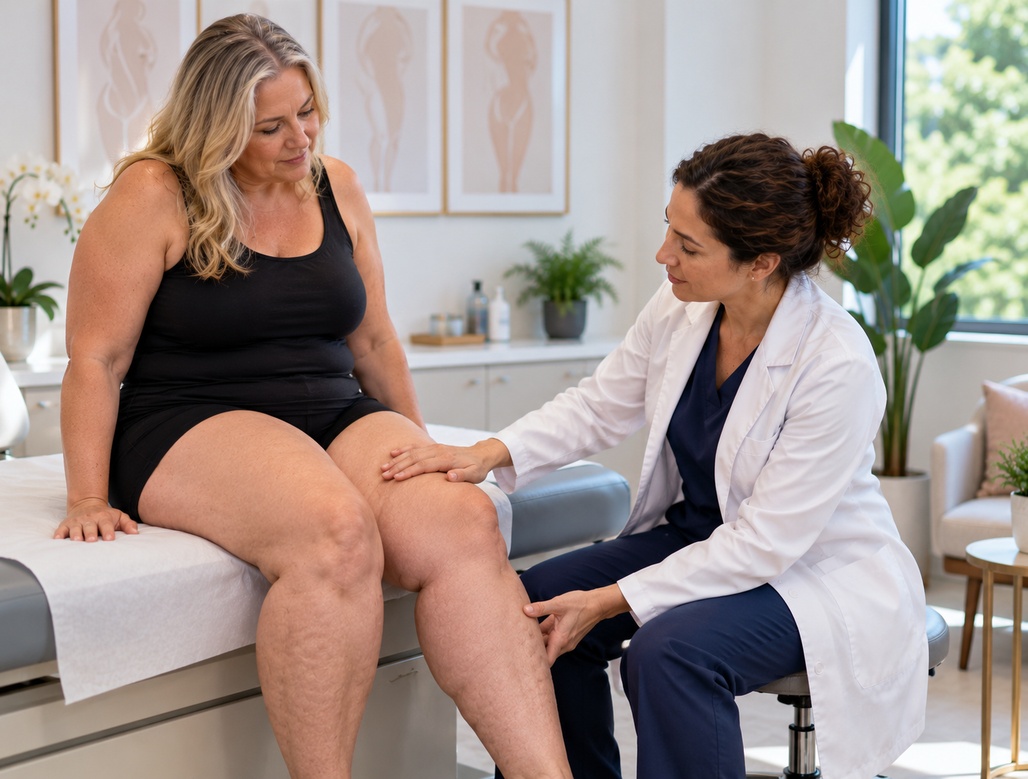
Advanced-stage lipedema is not a disqualifying condition for surgical treatment. Many patients who have lived with progressed disease for years, and who have wondered whether they have waited too long, remain candidates for meaningful intervention. Byrd Lipedema Surgery Center evaluates patients at all stages of the condition. Call (770) 587-1711 or contact us online to schedule a specialist assessment.
Lipedema progresses over time, and the tissue characteristics of advanced disease differ in important ways from earlier stages. The fat deposits become denser, more fibrotic, and more resistant to the mechanical forces involved in surgical removal. Those differences are real, and they affect both technique selection and what a patient can realistically expect from surgery. Power-assisted liposuction addresses the mechanical challenge of denser tissue in a way that other techniques do not, which is why it plays a specific role in the surgical management of later-stage lipedema. Here is what patients with advanced disease should understand before making a decision about surgery.
How Do Power-Assisted Cannulas Move Through Fibrotic, Heavier Lipedema Deposits?
In the earlier stages of lipedema, the affected fat tissue is softer and more accessible to surgical removal. As the condition advances, the tissue undergoes fibrosclerotic changes that make it denser, harder, and more resistant to a cannula moving through it. This is not simply a matter of volume. It is a qualitative change in the tissue itself that creates a different surgical environment and requires a different mechanical approach.
Power-assisted liposuction addresses this through a cannula that moves in a rapid, controlled reciprocating motion rather than relying solely on the surgeon's manual back-and-forth strokes. That oscillating action allows the cannula tip to move through fibrotic tissue more efficiently, fragmenting and dislodging the denser deposits with less resistance and with reduced physical demand on the surgeon. In tissue that would require significantly more force to traverse manually, the power-assisted mechanism maintains consistent, controlled movement that would be difficult to replicate through manual technique alone across a large treatment area.
The practical consequence of this efficiency is that the surgeon can work more thoroughly through the affected tissue in the available surgical time, which matters when the treatment area is extensive. Advanced-stage lipedema frequently involves large volumes of affected tissue across multiple body regions, and a technique that moves through that tissue effectively without requiring excessive force contributes to a more complete result. It also reduces the fatigue variable in a long surgical case, which has implications for the consistency of the work across the full duration of the procedure.
What Results Are Realistic for Patients With Advanced-Stage Lipedema?
Honesty about realistic outcomes is one of the most important things a lipedema specialist can offer a patient with advanced disease, and it begins with distinguishing between what surgery can accomplish and what it cannot. Lipedema liposuction at any stage, including advanced, is not a cure. It is a debulking procedure that removes the pathological fat tissue, reduces the pain and heaviness associated with that tissue, and can significantly improve mobility and quality of life. Those are meaningful goals, and for many patients with advanced lipedema they represent a substantial change in how they experience their body and their daily life.
What surgery does not do is reverse the underlying condition or restore tissue that has been affected by secondary lymphedema in patients where both conditions are present. Patients with lipo-lymphedema, the combination of lipedema and secondary lymphedema that can develop in advanced disease, require a treatment plan that addresses both components. Surgery can reduce the lipedema tissue burden, which in turn reduces the load on the already-compromised lymphatic system, but lymphedema management through compression and manual lymphatic drainage remains part of the long-term picture.
Volume reduction in advanced-stage lipedema can be significant. Patients frequently report meaningful reductions in pain, improved ease of movement, better fit in clothing, and a reduction in the disproportionate appearance of the affected limbs. The degree of improvement depends on the extent of the disease, the number of treatment sessions planned, the patient's overall health, and their commitment to post-operative care. A specialist who has treated advanced-stage lipedema across a meaningful patient population can give a prospective patient a realistic picture of what outcomes have looked like for others in comparable situations.
Why Is Staging Multiple Procedures Often Part of the Plan?
Advanced-stage lipedema typically involves more tissue than can be safely and thoroughly addressed in a single surgical session. Surgical safety parameters limit the volume of fat that can be removed in one procedure, and those limits exist for good reason. Attempting to treat too large an area in a single session increases anesthetic exposure time, raises the risk of fluid shifts and related complications, and compromises the surgeon's ability to work with precision and thoroughness across the full treatment area.
Staging the treatment means dividing the affected areas into sessions planned in a logical sequence, allowing adequate healing between procedures, and building toward a comprehensive result over time. A common approach treats different body regions in separate sessions: lower legs in one procedure, thighs in another, arms if affected in a subsequent session. The staging plan is developed based on the individual patient's anatomy, the severity of disease in each region, and the priorities the patient brings to the conversation about what is affecting their quality of life most significantly.
One patient came to us after living with lipedema and the chronic pain it caused for many years. As her symptoms had worsened over time, she had come to fear that she had waited too long and that surgery might no longer be able to help her. We explained that power-assisted liposuction can still be an appropriate option for patients with advanced disease, walked through what a staged treatment plan might look like for her specific presentation, and gave her a clear and honest picture of what meaningful improvement could look like. She left the consultation with something she had not had in a long time: a realistic basis for hope that treatment was still available to her.
Staging also gives patients time to recover fully between procedures, to continue any adjunctive therapies that support lymphatic function, and to assess the results of each session before proceeding to the next. That incremental approach is both safer and, for many patients, psychologically easier to manage than facing the full scope of treatment as a single undertaking.
Why Does a Specialist Assessment Matter Before Deciding on Surgery?
Advanced lipedema is not a uniform presentation. Two patients who are both described as stage three may have very different tissue characteristics, lymphatic involvement, mobility limitations, and health histories that affect what surgery can accomplish and how it should be approached. A generalist liposuction surgeon may not have the experience to recognize those distinctions or to plan treatment accordingly. A lipedema specialist evaluates the nuances of the individual presentation and recommends an approach that is appropriate for that specific patient rather than applying a standard protocol.
The assessment also establishes whether any factors in the patient's health history require attention before surgery can safely proceed. Advanced-stage lipedema is frequently accompanied by other conditions, and a thorough pre-surgical evaluation identifies anything that affects surgical risk, recovery expectations, or the sequencing of a staged treatment plan. Patients who have been told elsewhere that their condition is too advanced for surgery, or who have been offered only conservative management without a surgical option, may benefit from a second opinion from a center that focuses specifically on lipedema.
If you have advanced-stage lipedema and have questions about whether surgery is still an option for you, call Byrd Lipedema Surgery Center at (770) 587-1711 or schedule a consultation online. Our power assisted liposuction program is designed for the specific demands of lipedema tissue, including at later stages of the condition.