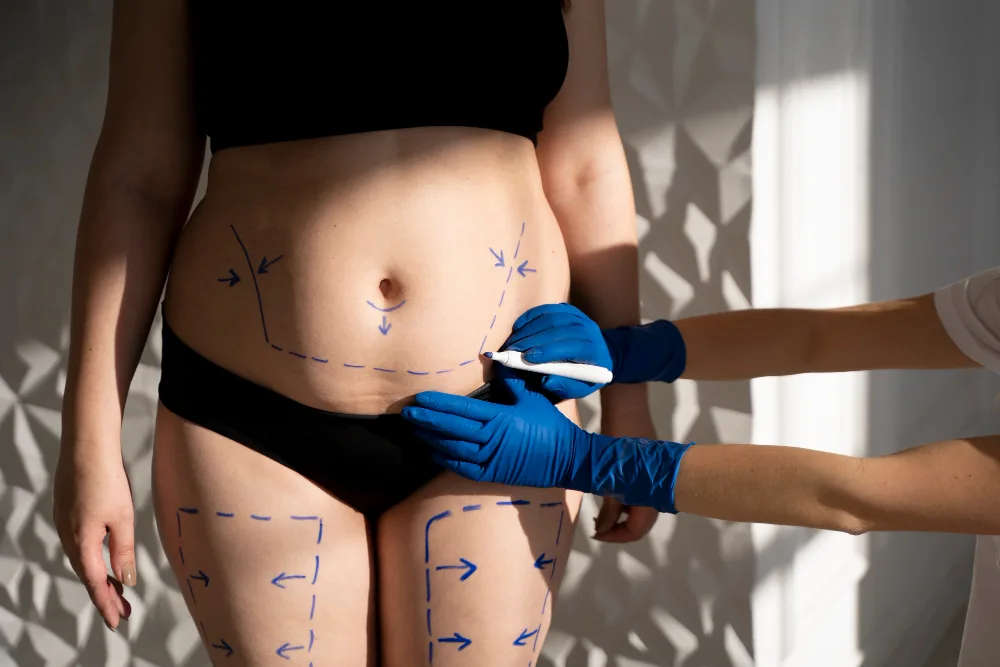
You have tried every diet in the book. You spend hours at the gym, tracking every calorie and step. You see the numbers on the scale drop, and you notice your face and waist getting thinner. But your legs? They stay the same.
For millions of women, this is a heartbreaking and confusing reality. You might feel like you're failing, or that you just aren't working hard enough. But here is the truth: It is not your fault. You are likely dealing with Lipedema, a condition that affects the way your body stores fat.
Understanding the difference between Lipedema fat and normal body fat is the first step toward regaining control of your life. It validates your experience and explains why standard weight loss methods haven't touched those stubborn areas.
What is Lipedema and why does it happen?
Lipedema is a chronic disorder of the fatty tissue that primarily affects women. It causes an abnormal accumulation of fat cells, usually in the legs, thighs, hips, and sometimes the arms. Unlike typical weight gain, which happens evenly across the body, Lipedema targets specific areas while leaving others—like the hands and feet—completely unaffected.
This condition is far more common than most people realize. In fact, estimates suggest it affects up to 11% of the female population worldwide, according to research published by the National Institutes of Health. Because it's often misdiagnosed as simple obesity, many women go years without proper treatment.
For those seeking relief, specialized removal is often necessary. Dr. Marcia Byrd prioritizes safety and precision, often utilizing power assisted liposuction in her Roswell practice. This technique uses a vibrating cannula to break up fat cells gently, which is crucial for protecting the sensitive lymphatic vessels surrounding the diseased fat.
What makes Lipedema fat feel different?
One of the easiest ways to tell the difference between these two types of fat is by touch. Normal fat generally feels smooth and soft. If you press on it, it simply feels like flesh.
Lipedema fat has a distinct texture. Many women describe it as feeling like there are "beans in a bag" or small frozen peas beneath the skin. As the condition progresses, these nodules can become larger, feeling more like walnuts or plums.
Does your fat hurt? Normal fat does not cause pain when touched. Lipedema fat, however, is often tender, painful to the touch, and bruises with little to no cause. You might bump into a coffee table and end up with a large bruise that lasts for weeks, or find bruises and have no idea where they came from.
How does normal fat behave compared to Lipedema?
Normal body fat acts like a bank account for energy. When you consume more calories than you burn, your body deposits energy into your fat cells. When you burn more calories than you eat, your body withdraws that energy, and the fat cells shrink.
Lipedema fat does not play by these rules. It is metabolically different. Think of it like a savings account that you can deposit money into, but the bank has lost the key to let you withdraw it. You can starve yourself and exercise for hours, and while your upper body might become skeletal, your legs will remain heavy and painful.
This is why Lipedema liposuction is often the only effective method for reducing the bulk of this diseased tissue. Standard weight loss efforts simply cannot target these specific cells.
What are the visual signs to look for?
Symmetry is a huge indicator. Lipedema almost always affects both legs equally. If you have "saddlebags" on one side but not the other, it's likely not Lipedema.
Another classic sign is the "cuff." Because Lipedema fat stops at the ankles or wrists, it creates a distinct line where the swollen tissue ends and the normal foot or hand begins. It can look like you're wearing pantaloons or a tight bracelet of tissue. If you look at your feet, and they seem completely normal despite heavy calves, that is a strong indicator of Lipedema.
If you're walking around Alpharetta or shopping in Roswell and feel self-conscious because your upper body is a size 6, but your bottom half is a size 16, you're displaying the disproportionate build that is characteristic of this condition.
How is Lipedema treated effectively?
While there is currently no cure for Lipedema, the condition can be managed. Conservative therapies, such as wearing compression garments, manual lymphatic drainage, and anti-inflammatory diets, can help reduce pain and swelling. However, these methods will not remove the fat that has already accumulated.
For a significant reduction, surgery is the primary option. Dr. Byrd utilizes water-jet assisted liposuction (WAL) for many of her patients. This method uses a fan-shaped jet of water to gently detach fat cells from the tissue structure.
This matters because preserving your lymphatic system is vital. Aggressive, traditional liposuction can damage lymph vessels, potentially leading to Lymphedema (permanent swelling). WAL is much gentler, washing the fat away rather than scraping it, which minimizes trauma to the body.
What are the costs and safety limits?
Understanding the logistics of surgery is part of the journey. When you come in for a consultation at our center, the fee is $200, which goes toward your personalized assessment.
Safety is our number one priority. During Lipedema liposuction surgeries, hospitals and surgery centers generally set a strict limit on how much can be removed in a single session to ensure patient safety. Typically, this limit is 5,000 mL (5 liters) of total fluid and fat. This means, if you have a significant amount of Lipedema fat, you may require multiple procedures to achieve your desired results safely.
We focus on getting you the best results without compromising your health, treating this as a medical necessity rather than just cosmetic improvement.
Why won't diet and exercise fix this?
This is the most frustrating myth we have to bust. Society—and often the medical community—tells women that if they just tried harder, they wouldn't look this way.
Diet and exercise are wonderful for your heart, your mental health, and for managing your "normal" fat. They prevent further weight gain, which can exacerbate Lipedema conditions. However, Lipedema liposuction removes the diseased fat cells that are resistant to diet and exercise. No amount of kale or cardio will dissolve a lipedema nodule.
Ready to stop blaming yourself?
Living with Lipedema is physically painful and emotionally draining. You may have spent years covering up your legs in the Georgia heat, avoiding pool parties, or feeling judged by doctors who didn't understand your condition.
You deserve to be heard, and you deserve a life free from the pain and heaviness of Lipedema.
If you suspect you have this condition, do not wait for it to progress. Contact Byrd Lipedema Surgery Center today at (770) 587-1711 to schedule your consultation. Let us help you take the first step toward mobility and relief.