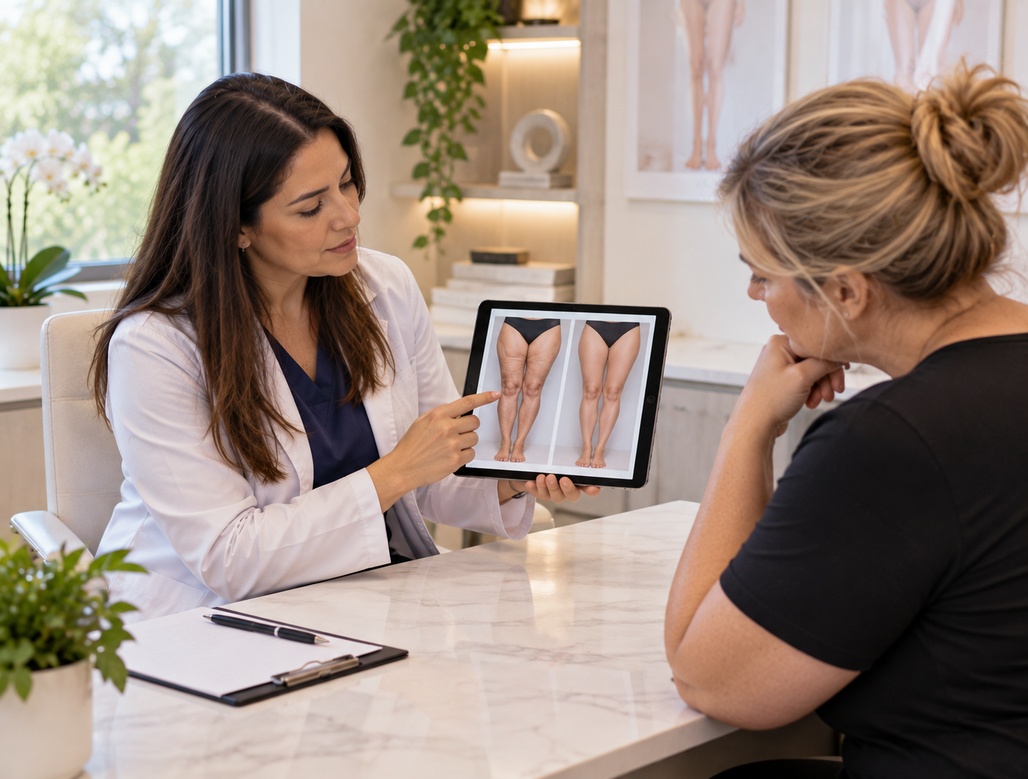
Before-and-after galleries are the most widely used tool for evaluating a lipedema surgeon, and they are also among the most frequently misread. Learning to interpret what you are seeing accurately is worth the time before you draw conclusions about any center. Byrd Lipedema Surgery Center reviews comparable cases with prospective patients during consultations and welcomes those conversations at (770) 587-1711 or through our online contact form.
Scrolling through surgical photo galleries is one of the first things most prospective lipedema patients do when they start researching surgery. It makes sense as a starting point. You want to see what results look like before you commit to anything. The problem is that without a framework for reading the photos critically, it is easy to be misled by presentations that look impressive without being informative, or to dismiss results that are genuinely meaningful because the before-and-after does not match what you were hoping to see. Here is how to look at these galleries with the eyes of someone who knows what to look for.
How Do You Match a Photo Patient's Stage and Body Type to Your Own?
The most relevant before-and-after photos in any gallery are the ones that most closely resemble your own presentation. A dramatic result in a patient with earlier-stage lipedema limited to the lower legs tells you very little about what surgery might accomplish for someone with advanced disease affecting the thighs, hips, and arms. Looking at those photos and feeling discouraged because the result does not seem to apply to you, or encouraged because you are projecting your own situation onto a case that does not match it, are both errors that the same misalignment produces.
When reviewing a gallery, look specifically for patients whose disease stage, affected areas, and body proportions are similar to yours. If your lipedema is primarily in the thighs and lower legs at a moderate stage, look for cases that reflect that presentation rather than gravitating toward the most visually striking results regardless of their relevance. A gallery that includes cases across a range of stages and presentations is more informative than one that shows only the most favorable outcomes, because it suggests the center is treating a realistic patient population rather than curating only the easiest cases for public display.
Stage matters because the tissue characteristics change as lipedema progresses, and the degree of improvement achievable through surgery reflects those differences. A patient with earlier-stage lipedema may see more pronounced shape change from a single procedure. A patient with advanced fibrotic disease may achieve results that are less visually dramatic but equally meaningful in terms of pain reduction, improved mobility, and tissue volume reduction. Both are legitimate outcomes, but they look different in photographs, and conflating them leads to expectations that do not fit the actual situation.
What Do Consistent Lighting, Angles, and Time-Since-Surgery Tell You About a Gallery?
The technical consistency of a before-and-after gallery is itself a signal about how seriously a center takes accurate documentation. Photographs taken under inconsistent lighting, at different angles, or with the patient posed differently in the before and after shots cannot be used to make an honest visual comparison. Lighting that washes out shadows in the after photo will make contour changes appear more pronounced than they are. An angle shift between before and after, even a subtle one, changes how volume and shape read in the image. These are not always deliberate manipulations, but their effect on what the images communicate is real regardless of intent.
A gallery that uses standardized photography, meaning consistent lighting, consistent distance from the patient, and consistent anterior, lateral, and posterior views for each case, is demonstrating a commitment to documentation that lets the images speak honestly. When you see before-and-after pairs where the lighting is notably different, where the patient is positioned at a noticeably different angle, or where the after photo is taken from a more flattering perspective than the before, those inconsistencies are worth noting before you draw conclusions about the result.
Time since surgery is the other documentation variable that affects what you are seeing. Lipedema liposuction results continue to develop for six months to a year as post-operative swelling resolves and the treated tissue settles. An after photo taken at six weeks will show a patient who is still swollen and whose results are incomplete. An after photo taken at twelve months shows a mature result. A gallery that does not indicate when the after photos were taken gives you no basis for knowing which you are looking at. Ask, when reviewing cases with a surgeon's team, how long after surgery the after photos were taken and whether longer-term follow-up images are available.
What Does Realistic Improvement in Shape, Pain, and Mobility Look Like?
Photographs capture shape change. They do not capture the improvements in pain, heaviness, tenderness, and mobility that most lipedema patients report as the most significant outcome of successful surgery. When evaluating a surgeon's results, it is worth keeping in mind that the visual result in a photograph represents only a portion of what the procedure accomplished for that patient. A result that looks modest in photographs may represent a transformation in daily function that the patient values far more than the visible shape change.
Realistic shape improvement after lipedema liposuction typically includes a reduction in the disproportionate volume of the affected limbs relative to the rest of the body, a smoother contour in areas where nodular or irregular tissue was present, and a reduction in the heaviness and column-like appearance that characterizes moderate to advanced lipedema. What it does not typically include is a complete normalization of limb appearance, a result equivalent to cosmetic body contouring in non-lipedema tissue, or a permanent elimination of the condition's underlying disease process.
When a gallery shows results that appear to transform patients from advanced lipedema to a near-normal lower-body appearance in a single procedure, that presentation warrants skepticism rather than admiration. Either the before photos represent an earlier stage than they appear, the after photos were taken at a flattering angle or before swelling was fully resolved, or the documentation is not accurate. A center whose gallery reflects honest, staged improvements over a realistic treatment arc is showing you what lipedema surgery actually delivers, which is meaningful and worth pursuing, even if it is less visually dramatic than a curated marketing presentation.
Why Does a Live Consultation Beat Guessing From Images?
A prospective patient came to us after spending significant time studying online before-and-after galleries without feeling any closer to understanding what surgery might mean for her own body. The photos she had seen ranged from impressive to underwhelming, and she had no framework for knowing which cases were comparable to hers or how to read the results honestly. During the consultation, we pulled comparable cases from our own records, walked through the disease stage and treatment approach for each, and explained the outcomes in terms of both visual change and the functional improvements the patients had reported. The conversation did not just help her understand the photos. It helped her understand what she was actually deciding.
That conversation is what a gallery cannot replace. A photograph shows you a result. A consultation with a specialist shows you whether that result is comparable to your situation, what the treatment plan that produced it involved, what the patient experienced during recovery, and what a realistic expectation looks like for someone with your specific presentation. It also gives you the opportunity to ask questions that no gallery answers: how many procedures the result required, what technique was used and why, and what the patient's functional experience looked like beyond the visual outcome.
A center that encourages you to schedule a consultation before making any decisions, and that uses that consultation to review real cases in context rather than to deliver a sales presentation, is a center operating in your interest rather than its own. The goal of the consultation is to help you make a decision you can stand behind, whether that decision is to move forward with surgery or to take more time. Guessing from images gets you closer to a decision, but it does not get you there with the accuracy you need for a surgical commitment.
If you are evaluating lipedema surgeons and want to review cases comparable to your own in a live consultation, call Byrd Lipedema Surgery Center at (770) 587-1711 or schedule your consultation online. Our team can discuss which of our approaches, including power assisted liposuction, water-jet assisted liposuction, or ultrasonic assisted liposuction, fits your presentation and what realistic outcomes look like for patients like you.