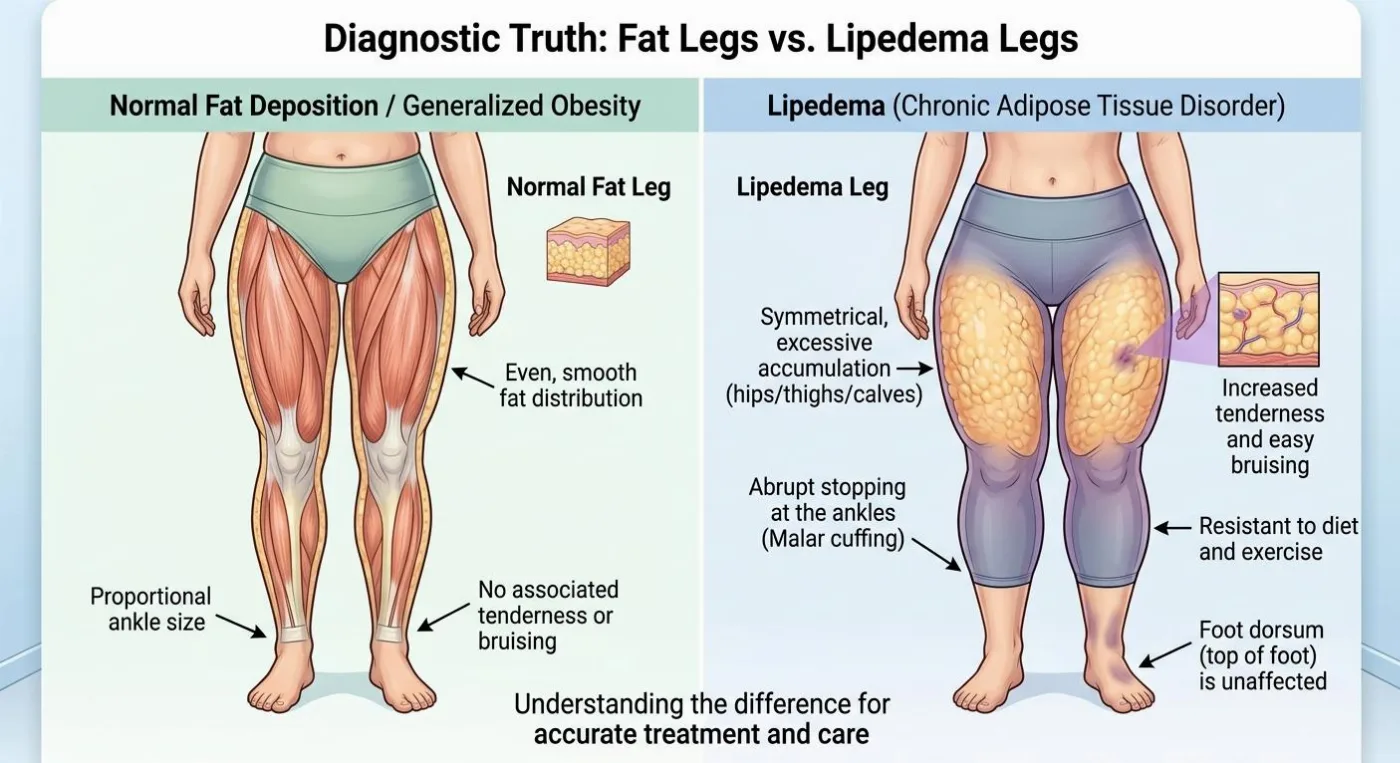
The difference between fat legs vs Lipedema legs comes down to symmetry, pain, and response to diet. General fat responds to calorie deficits and exercise. Lipedema is a chronic, painful fat disorder that creates disproportionate lower bodies and requires specialized medical intervention rather than lifestyle changes.
Many women spend decades blaming themselves for stubborn lower body weight that refuses to budge. They restrict calories and exercise daily, yet the painful swelling remains. If you suspect your struggles go beyond standard weight gain, you are not alone. Please contact Byrd Lipedema Surgery Center at (770) 587-1711 to schedule a consultation.
Lipedema is a distinct medical condition, not a personal failure. We created this guide to help you differentiate between general leg fat and Lipedema, helping you find the diagnostic truth you deserve.
Consider Sarah, a patient who traveled to our clinic near historic Canton Street in Roswell, GA. For 15 years, doctors told her to just eat less. She endured constant gaslighting while her legs bruised easily and throbbed with pain. When she finally received our specialized lymphatic assessment protocols, we confirmed she had Lipedema. Our center serves as a beacon of hope for women like Sarah who just want their pain acknowledged and treated.
What Causes Conventional Fat Legs?
General leg fat accumulates due to lifestyle habits, diet, and genetics. Standard body fat responds well to a 500-calorie daily deficit and consistent cardiovascular exercise. Patients typically see a 10% to 15% reduction in leg circumference over six months of dedicated weight management.
Standard fat accumulation happens evenly throughout the body. If you eat a high-calorie diet and lack consistent physical activity, your body stores that excess energy as fat. Your genetics also play a role in where your body prefers to store this weight. For many women, the hips, and thighs are natural storage areas.
When dealing with conventional fat, a healthy diet and targeted exercises will yield results over time. If you incorporate strength training and reduce your caloric intake, those fat cells will shrink. These standard methods fail completely for patients suffering from Lipedema.
What Are the Key Symptoms of Lipedema?
Lipedema is a chronic, progressive fat disorder that primarily affects women and causes symmetrical fat accumulation from the hips to the ankles. The feet remain completely spared. Symptoms include extreme tenderness to touch, easy bruising, and a disproportionate body shape where the waist stays small while the lower body expands.
This condition is vastly different from standard obesity or lymphedema. The fat tissue itself changes texture. Many patients describe feeling small, pearl-like nodules under their skin. This nodularity increases as the condition progresses into later stages.
Hormones heavily influence Lipedema. Patients often notice their symptoms rapidly worsening during major hormonal shifts like puberty, pregnancy, or menopause. Unlike lymphedema, which often affects just one limb, Lipedema almost always presents symmetrically on both sides of the body.
How Do You Tell Fat Legs vs. Lipedema Legs Apart?
You can distinguish fat legs vs. Lipedema legs by looking for bilateral symmetry, painful tissue, and unaffected feet. Lipedema fat feels like small marbles under the skin and does not shrink with diet or exercise. A negative Stemmer's sign also helps rule out standard lymphedema.
The diagnostic dilemma causes immense frustration. Misdiagnosis is incredibly common because many medical professionals lack training in fat disorders. Here is a clear breakdown to help you understand the differences:
- Symmetry: Lipedema is always symmetrical and bilateral. General fat can be asymmetrical.
- Pain and Tenderness: Lipedema fat hurts when pressed. General fat rarely causes physical pain.
- Feet Involvement: Lipedema spares the feet, creating a distinct "cuff" at the ankle. General fat often involves the feet and toes.
- Bruising: Lipedema patients bruise very easily without remembering an injury. General fat does not increase bruising.
- Response to Diet: Lipedema shows little to no change in the affected areas despite strict dieting. General fat responds predictably to calorie deficits.
Our technicians typically find that patients show a negative Stemmer's sign. This means you can still pinch and lift the skin at the base of the second toe, which helps differentiate Lipedema from lymphedema. Proper medical diagnosis is critical to stop the disease's progression.
When Should You Seek Expert Lipedema Help?
Consult a Lipedema specialist immediately if you experience persistent leg pain, unexplained bruising, and fat that ignores your strict diet. Early diagnosis prevents irreversible joint damage and mobility loss. Our team evaluates your medical history and performs a physical exam to rule out other vascular conditions.
Do not wait until your mobility is severely compromised. If you notice your upper body shrinking while your lower body continues to grow, you need expert evaluation. You should look for specialists who understand lymphatic and adipose tissue disorders, such as phlebologists or dedicated Lipedema surgeons.
In our 30 years serving Lipedema patients, we have learned that early intervention drastically improves long-term outcomes. During a consultation at Byrd Lipedema Surgery Center, we perform a thorough physical examination. We review your complete medical history and listen to your experiences to provide a definitive, accurate diagnosis.
How Do We Treat and Manage Lipedema?
Lipedema management requires a combination of conservative therapies and specialized surgical intervention. Conservative care includes wearing medical-grade compression garments daily and receiving manual lymphatic drainage. For permanent fat removal, lymph-sparing liposuction provides the most effective long-term relief.
Conservative management focuses on symptom relief. Manual lymphatic drainage (MLD) therapy helps move stagnant fluid out of the tissues. Low-impact exercises like swimming or cycling in the Chattahoochee River area keep joints moving without adding stress. Strict skin care prevents infections in deep tissue folds.
However, conservative measures will not remove the diseased fat. Surgical intervention offers a permanent solution. We use advanced, lymph-sparing techniques to safely extract Lipedema tissue. Power assisted liposuction uses a vibrating cannula to gently break up dense fat. We also utilize water-jet assisted liposuction to flush fat cells away from connective tissue safely. For highly fibrous areas, ultrasonic assisted liposuction melts the fat before removal, ensuring optimal contouring and minimal trauma to your lymphatic system.
Take the Next Step Toward Healing
Living with the pain and frustration of an undiagnosed fat disorder is exhausting. You do not have to accept a life of limited mobility and constant discomfort.
If you are ready to find real answers about fat legs vs. Lipedema legs, we are here to help. Contact Byrd Lipedema Surgery Center at (770) 587-1711 to schedule your comprehensive evaluation today.