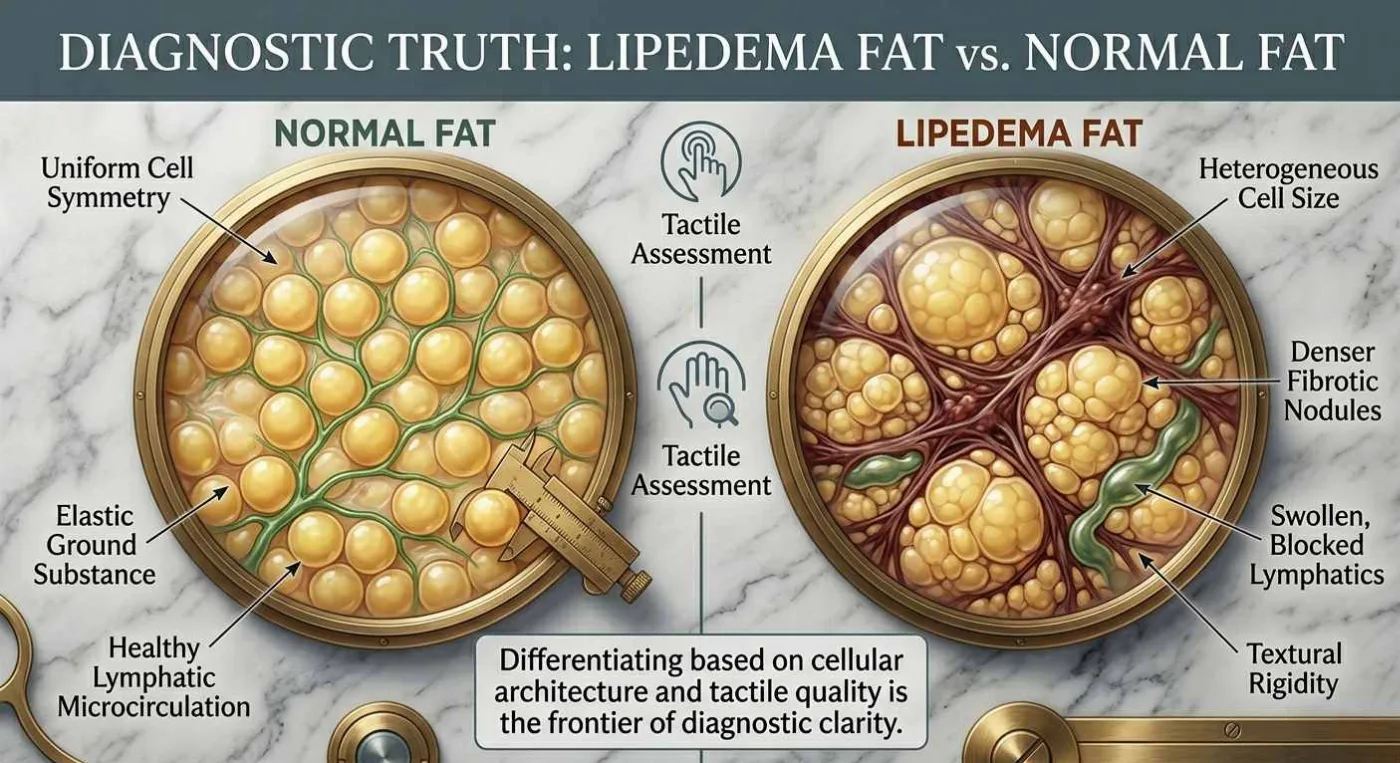
The main difference between Lipedema fat vs normal fat lies in its physical structure and response to diet. Lipedema tissue feels nodular, is painful to the touch, and fiercely resists caloric restriction. Normal fat feels smooth and decreases steadily when you maintain a caloric deficit over time.
Living with unexplained, painful swelling in your legs can feel incredibly isolating. Many women arrive at our Roswell, GA clinic exhausted after doctors tell them to simply eat less and exercise more. If you suspect you have this condition, reach out to Byrd Lipedema Surgery Center at (770) 587-1711 to schedule your consultation.
Consider Sarah, a patient who recently drove past the historic Roswell Mill to visit our clinic. For 15 years, her primary care physicians blamed her heavy, bruising legs on poor diet. She tried strict calorie counting and rigorous workouts. Her upper body shrank, but her legs only grew heavier and more painful.
When she finally walked through our doors near Canton Street, we performed our specialized lymphatic assessment protocols. Within 30 minutes, she had her answer. She wept upon hearing the truth. She had Lipedema. She wasn't lazy, and her condition was not her fault.
What Are the Key Differences Between Lipedema Fat vs. Normal Fat?
You can physically feel the difference between Lipedema fat vs normal fat. Lipedema tissue often feels like small marbles or peas beneath the skin. It causes extreme tenderness, bruises easily, and typically stops right at the ankles, leaving the feet unaffected. Normal fat feels soft, smooth, and distributes evenly.
In our 30 years of surgical experience, we find that up to 11% of adult women suffer from some stage of Lipedema. Unlike normal weight gain, Lipedema is a progressive connective tissue disorder. The fat cells actually grow abnormally large and trap fluid in the surrounding tissues. This creates a highly inflammatory environment that diet and exercise simply cannot fix.
When you lose weight through traditional methods, you burn normal fat. The Lipedema fat stays exactly where it is. This creates a disproportionate body shape where the lower half is significantly larger than the upper half.
Why Is an Accurate Lipedema Diagnosis So Hard to Find?
Most medical professionals receive less than one hour of lymphatic system training during medical school. They look at enlarged legs and immediately assume the patient is dealing with standard obesity. This lack of education leads to years of medical gaslighting for patients seeking relief from severe pain.
Accurate diagnosis requires specific clinical knowledge. Dr. Marcia Byrd uses targeted physical evaluations to distinguish between standard obesity, lymphedema, and Lipedema. We check for the classic “cuffing” effect at the ankles. We test for pain upon light pressure. We look for hypermobility in the joints, which frequently accompanies the condition. Getting this diagnosis correct is the only way to formulate a treatment plan that actually works.
What Are the Best Surgical Treatment Options for Lipedema?
The most effective treatment for Lipedema is specialized, lymph-sparing liposuction. This removes the diseased fat cells permanently while protecting your delicate lymphatic system. Recovery from a single session typically involves wearing medical compression garments for 4 to 6 weeks to reduce swelling.
At Byrd Lipedema Surgery Center, we offer three primary surgical methods tailored to each patient's unique tissue type.
Water-jet assisted liposuction (WAL) uses a gentle, fan-shaped spray of fluid to dislodge fat cells. This prevents damage to nearby nerves or lymph vessels, making it highly effective for early-stage Lipedema.
Power assisted liposuction (PAL) features a vibrating cannula tip that efficiently breaks up dense, fibrous tissue. We often use this to reduce surgery time and minimize patient fatigue.
Ultrasonic assisted liposuction (UAL) uses sound waves to liquefy fat before extraction. This works perfectly for highly fibrotic areas that resist other removal methods.
How Can You Manage Lipedema Symptoms Daily?
You can manage daily Lipedema symptoms by wearing medical-grade compression garments and performing manual lymphatic drainage massage. These conservative therapies reduce tissue swelling and ease the heavy, aching sensation in your legs. Most patients need to dedicate 20 to 30 minutes every day to a consistent management routine.
Diet alone will not cure Lipedema. However, anti-inflammatory eating plans can help reduce overall body inflammation. Many of our patients find relief by adopting ketogenic or low-carbohydrate diets. These eating patterns help manage the fluid retention that makes Lipedema fat so painful. Staying active with low-impact exercises like swimming or water aerobics also helps push stagnant lymphatic fluid out of the legs.
The Bottom Line on Getting Proper Lipedema Care
You deserve a medical team that listens to your symptoms and understands your physical pain. Recognizing the physical differences between Lipedema fat vs normal fat is the first critical step toward reclaiming your mobility. Stop blaming yourself for a genetic, biological condition that you cannot control with diet alone.
If you are tired of being ignored by doctors, we are here to fight for you. We provide the expertise and the empathy you need to heal. Contact Byrd Lipedema Surgery Center at (770) 587-1711 to schedule your consultation and take your life back.